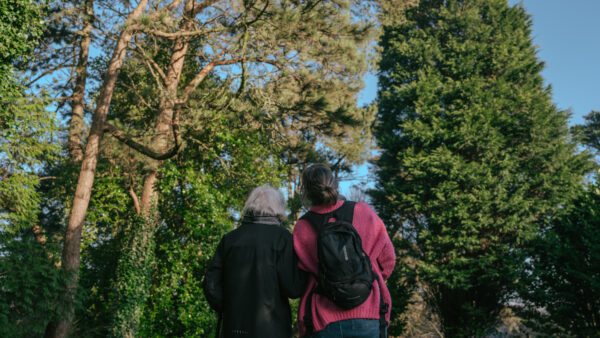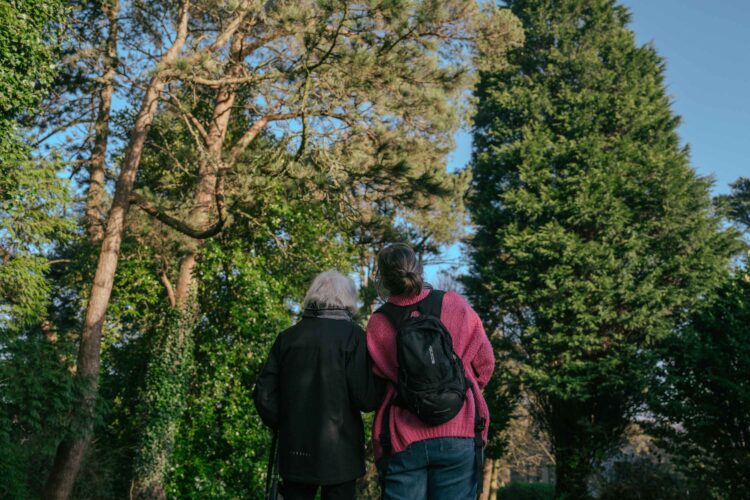
Dawn’s short-term memory is almost non-existent.
On most days, when her sons call and ask what she’s been up to, she can’t remember what happened ten minutes ago. They worry about her. She lives alone since her husband died. She doesn’t drive any more. Getting out depends entirely on other people.
But on the days Dawn attends her Creative Spaces walking group, something is different.
Her son noticed it first. On those days, her recall is stronger. The details stay with her longer. She comes home more herself. He describes it as the only thing she is consistently motivated to do.
He doesn’t fully understand why. But he doesn’t question it.
By the end of this post, you will understand exactly what is happening physiologically when a person with dementia steps outside, why it works even when memory is significantly affected, and why it is worth referring into your local dementia friendly walking group. There is a clear answer to why Dawn comes home different on those days. This is it.
For nearly 20 years, we have been running the Creative Spaces walking and nature programme, supporting people living with dementia and their carers across Cornwall.
Most people working in dementia care have seen the version of this that they can’t quite explain. Someone who has been agitated or withdrawn for hours steps outside, hears birdsong, feels the sun, and something shifts. The tension changes. They start to talk.
It looks like a small miracle. It isn’t.
When the nervous system has no way to settle, the body stays in a state of low-level threat. Cortisol, the stress hormone, keeps circulating. Anxiety rises. Agitation rises. Cognitive function dips further. What looks like resistance or distress is often a physiology that has been running on high alert, sometimes for months.
Natural environments directly interrupt that cycle.
Birdsong and moving water are acoustically simpler than most indoor environments. They reduce stimulation in the part of the brain that detects threat. A less reactive threat response means fewer alarm signals, and the whole stress cascade quietens. The sounds of nature are hardwired to signal safety to the brain. For someone whose nervous system is already under significant strain, that signal is not small.
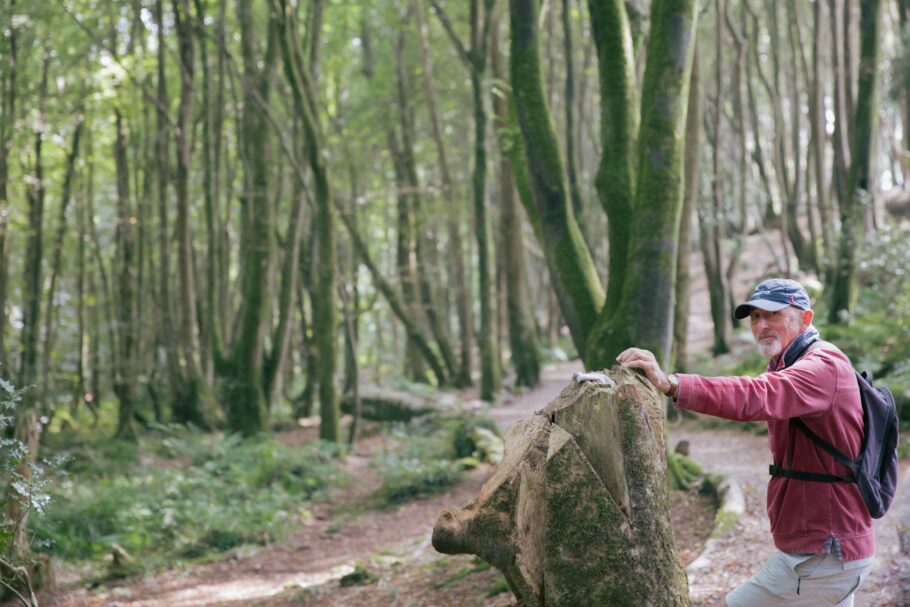
Faster than most people expect.
Research shows that around twenty minutes in a natural environment produces a measurable drop in stress hormones (1). The steepest reduction happens between twenty and thirty minutes of simply sitting or walking outside. This is not a long programme of rehabilitation. It is a physiological response within a single session.
This is the question that matters most in dementia care, and the answer is yes.
The parts of the brain most affected in the early stages of Alzheimer’s disease handle conscious recall, names, recent events, and sequences. That is the damage that is most visible and most distressing for families. But nature does not ask for any of that.
Natural environments draw what researchers call soft fascination, the effortless, almost involuntary attention we give to moving water, light shifting through leaves, and the sound of wind. The brain is not being tested. It is not being asked to retrieve or perform. It is simply held, and the systems that have been straining get to rest.
Someone may not be able to tell you the name of the bird they just watched. But their nervous system still registered it.
This is where the neuroscience connects directly to what Dawn’s son observed.
For example, in Alzheimer’s disease, the brain regions that carry the felt sense of an experience, the body-based, emotional imprint of having been somewhere, remain relatively intact until the later stages. What deteriorates first is episodic memory, the ability to consciously retrieve what happened and when.
Which means someone may not remember being outside. But they can carry the calm from it for hours. They may not be able to tell you what they did. But the session lives in the body even when it has left the mind.
Dawn’s son put it better than any research paper: on a Sensory Trust day, her recall is much stronger, and it stays with her a lot longer.
That is not a coincidence. The richer sensory experience of being in nature creates stronger encoding, even in a brain that is losing its usual retrieval routes. It reaches parts of memory that a conversation in a living room cannot.
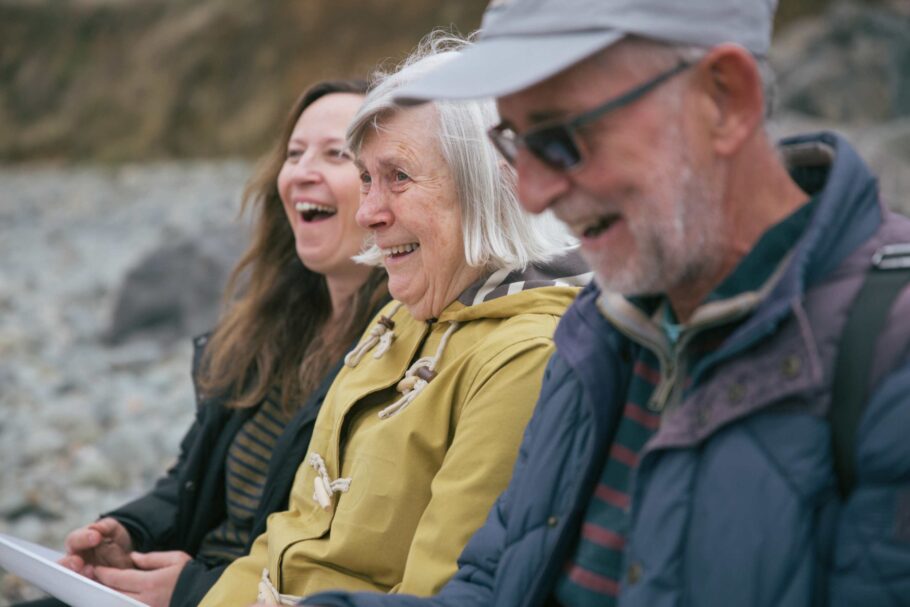
In our Creative Spaces year three report, 100% of survey respondents reported positive impacts on their health and wellbeing from attending our groups. An independent evaluator observed one member arrive visibly distressed and noted his mood had lifted by the end of the session.
The areas that consistently show improvement in nature-based dementia programmes are engagement, agitation, mood, sleep and, notably, reduced need for medication. Better verbal communication appears too, with people talking more, following conversation more easily and staying present for longer.
The quotes from Creative Spaces members say it plainly.
‘I feel easy. I love the way everyone is lifted up, even if they have problems.’
‘I don’t worry about my symptoms.’
‘I love to feel the wind in my hair. It makes me feel alive.’
These are not dramatic clinical recoveries. They are windows of connection. Anyone who works with people with dementia knows how much those windows matter, and how rarely they happen indoors.
This is worth naming, because it is often the part that gets missed.
The same physiological response applies to whoever is in nature alongside the person with dementia. Walking outside produces measurably lower stress hormones than exercising indoors, and this holds, even under real-life conditions of sustained pressure.
Co-regulation is real. A calmer nervous system alongside someone with dementia supports a calmer nervous system in them. The walk is not just good for the person with dementia. Carers in the Creative Spaces groups consistently report that attending is as much a benefit to them as to the person they support.
‘It’s as much a break for me as it is for Paul.’
‘Being with the group keeps me alive and in touch with things. It lifts me up when I am down.’
Referring someone into Creative Spaces is not just a referral for the person with the diagnosis. It is support for the whole family.
Not always, but a regular, structured programme removes the barriers that stop people from accessing something that genuinely helps.
The evidence does not require a particular setting or level of fitness. Fifteen minutes outside produces measurable benefits. But for many people living with dementia, and especially those in rural Cornwall, the logistics are the problem. They can no longer drive. Family live at a distance. Existing groups don’t feel right.
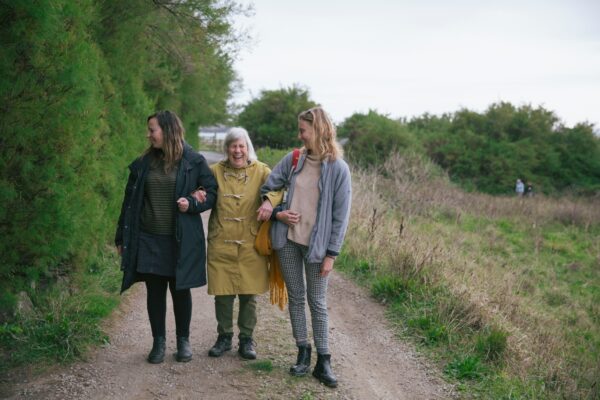
Creative Spaces groups are small, free, unhurried and designed to work for people with mixed abilities, including those using mobility aids and wheelchairs. Routes are planned to suit the group on the day. Nobody is left behind.
‘I have problems walking fast and that makes me reluctant to join groups, but this one had no difficulties for me.’
People living with dementia in Cornwall, primarily early to mid-stage, and their carers. The groups run across nine rural locations and are free to attend. Referrals are welcomed from social prescribers, community connectors, community navigators, GPs, primary care dementia practitioners and family or self-
There is no complex referral pathway. If you have someone on your caseload who is becoming more isolated, whose carer is struggling, or who would benefit from regular time outside with people who understand, this is worth knowing about.
How to refer
Call and leave a message on our answerphone and someone from the Creative Spaces team will get back to you. Or email [email protected]
If this is useful, pass it on. The people most likely to benefit are the ones whose support networks know this exists.
References
(1) Hunter, M.C., Gillespie, B.W. and Chen, S.Y. (2019) ‘Urban Nature Experiences Reduce Stress in the Context of Daily Life Based on Salivary Biomarkers’, Frontiers in Psychology, 10, p.722. https://doi.org/10.3389/fpsyg.2019.00722 This study measured cortisol levels in adults before and after time in nature. It found that 20-30 minutes in a natural environment produced the steepest drop in stress hormones.
Urban Nature Experiences Reduce Stress in the Context of Daily Life Based on Salivary Biomarkers’, Frontiers in Psychology, 10, p.722. https://doi.org/10.3389/fpsyg.2019.00722 This study measured cortisol levels in adults before and after time in nature. It found that 20-30 minutes in a natural environment produced the steepest drop in stress hormones.