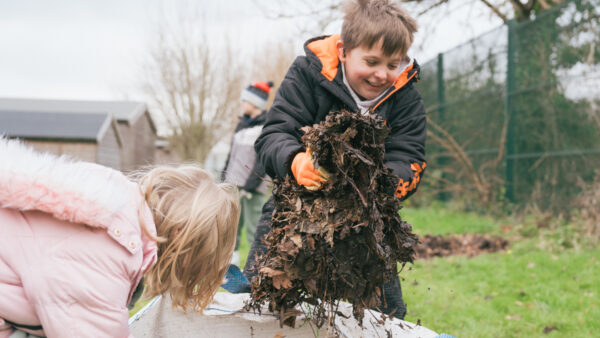
We have compiled a collection of activities, games and exercises that are all based around sound.
You will learn how to ‘tune in’ to your natural environment and discover a whole new world of sound. These ideas are suitable for everyone and can be adapted to suit any environment. You can turn a simple walk around your garden into a sound adventure.
Activities include;
- creating a sound hunt
- going on a sound walk
- guidance on how to record and illustrate a soundscape
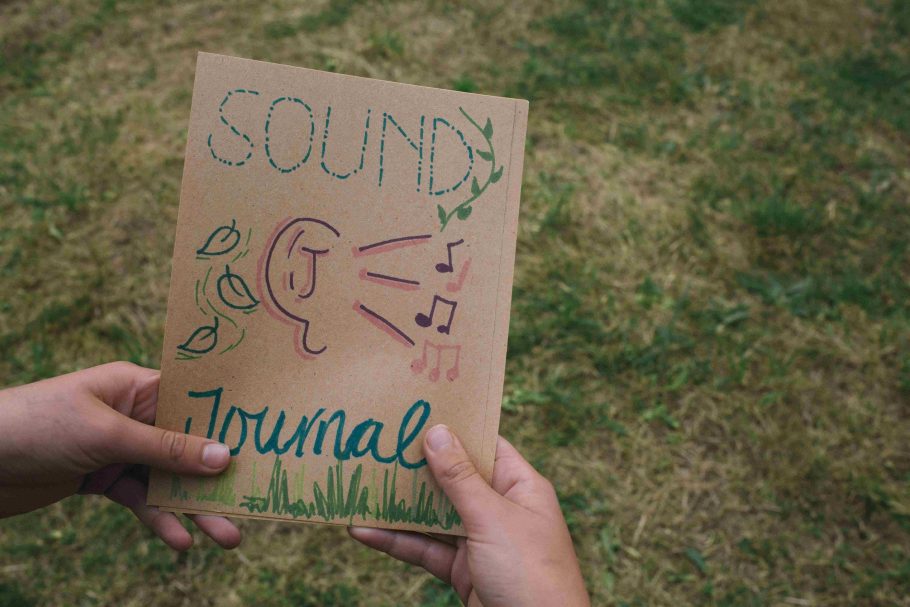
- keeping a sound journal
There are lots of ways to experience the sounds around us and to make listening fun. Here are a few activities that can be done on their own or combined together. These activities are designed to activate hearing and increase engagement with the environment through attentive listening. These activities can be done individually or as part of a group and range from simple 5 minute exercises to more involved sound ‘projects’.
This is a fun way of introducing attentive listening and can be done for just a couple of minutes. Be still and quiet and listen out for the sounds your own body is making. What can you hear? Which is the quietest sound of your body? Which is the loudest? How are the sounds different from each other? What is making the sound? Begin to move slowly, how do the sounds change? What can you hear now that you couldn’t before? Listen to the sound of your footsteps changing every time you hit a different surface. As you walk, what sounds are disappearing? Getting louder? Coming towards you? Moving away from you? Can you move without making a sound?
A collection of sounds are written out on paper (you can use the list from the bottom of this page) and put in a bag, everyone chooses one (or several) and then has to listen out for their sound throughout the visit. For example, try to find a low-pitched rumble, a high-pitched clang, and a swish. This is one way to begin to collect the sounds and their locations to describe the soundscape of an area.
This involves walking a route where the main sense being used is sound. There are many ways to do this. The purpose is to enable you to discover your environment through focused attention on a specific sense. As a group activity the whole group can assemble at the end to discuss verbally what they discovered or to ‘illustrate’ the soundscape on a map. It could be done in stages, with the whole group stopping at points along the way. Individuals could take turns to signal to the group to stop when they have heard a sound they want to bring everyone’s attention to.
Create a map of the area you are visiting. You can draw one, use an existing map, or print one from Google. If this is a group activity, make the map as large as possible.
Use the map to record the sounds you hear during your visit. Pay attention to the qualities of each sound:
- What kinds of rhythms are there?
- What pitches do you hear?
- Which sounds are continuous?
Try to describe the sound itself rather than (or as well as) the source of the sound, for example, write “grunt” instead of “pig.”
Repeat the sound mapping at different times, such as different times of day, at night, in different seasons, or in different weather conditions. This can help you explore how and why the soundscape changes.
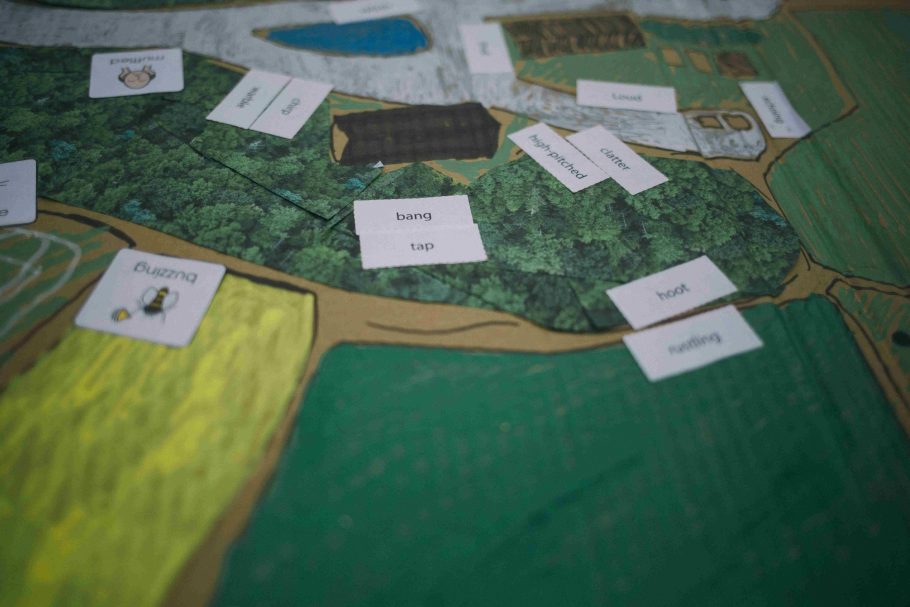
Pick out the sounds you like to hear the most and create the ideal soundscape you’d like to spend time in. How do you feel listening to sounds? Do some sounds make you feel irritated? Calm? Soothed? Excited?
Choose something in nature that you can hear, eg the wind, water, or birds. For a whole month, keep an ear out for your adopted friend. Listen to how its sound changes. Wonder why. Find new ways to describe what you are hearing. Mark your sounds on a map. Try drawing the shape and movement of the sounds, experiment with making audio recordings or perhaps capture your ‘soundmaker’ in a photo or on film.
For example, befriend the rain. Go out and listen to as many sounds created by rain as possible. Listen for low-pitched and high-pitched ones, for those which change in pitch and or loudness. Rain will sound different depending on where it is falling (dry ground, on glass, on tin, rain running off the roof). What kinds of structures produce what kinds of sounds when touched by rain? Note if the sounds make you feel anything.
Echoes are bouncing sounds: Find all the echoes in your environment and examine where they bounce off. Which ones are most interesting and why?
Simply do that – try and mimic the different sounds you can hear. In a group can you make music using these sounds – making beats and rhythms
Download below a comprehensive list of sound words for you to use as inspiration or as part of a sound game.