Design advice for making paths more accessible
The more accessible the path, the more people will be able to enjoy a space, and the less you will need to overcome barriers to access. The following notes are to help you design outdoor paths and routes that are accessible to people with limited mobility, wheelchair users and people with sensory impairments.
These are intended as an outline guide and not as detailed specifications. It is essential that any design conforms with current Building Regulations and relevant standards.
Pay particular attention to the following aspects:
Widths. Narrow paths limit use by wheelchair users and people who need someone alongside.
Surface materials: Avoid loose materials, such as gravel and soft bark. These are challenging for people with limited mobility, and often impossible for wheelchair users.
Free of hazards: Play it safe. Uneven and slippery surfaces, trip hazards and challenging gradients increase the risk of slips and trips, particularly for people with visual impairments and limited mobility.
Path width
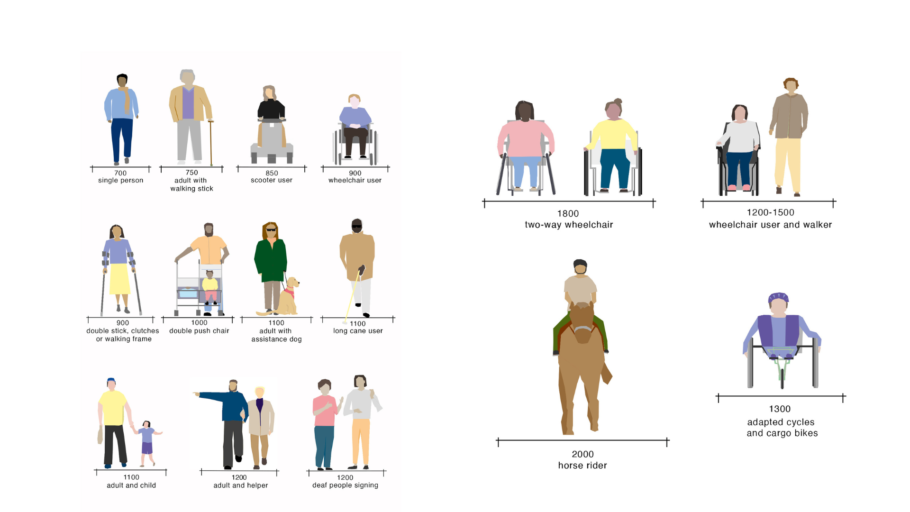
Ideal path widths will depend on the location of the path, the intended use and the intended volume of users. Don't just think about who is using it now, who do you want to see using it in future?
2m: allows room for two people to walk or wheel side by side and pass each other.
1.8m: room for two people to walk or wheel side by side.
1.2m: minimum path width.
On busy routes, passing places are particularly important. On path widths of 1.5m or less, provide passing places every 50m Where appropriate, these may also provide seating.
The diagrams below help inform design decisions and take into account a full range of users.
Gradients, crossfall, camber and resting places
Recommendations for maximum gradients, crossfalls and cambers of paths will depend on the style and use of the outdoor space. Always aim for the the Least Restritive Access. Any gradient steeper than 1:20 is considered a ramp and should be designed accordingly (see ramps and steps).
Paths, steps and ramps should have a slight cross-fall to shed water. However, a large crossfall will reduce the width of a usable path to a central strip, and a camber will force the user to journey at an angled slope downwards on one side. Both are tiring for most users, particularly those with wheels or who are unsteady on their feet.
Resting points are valuable to everyone and essential for some to be able to enjoy an outdoor space. The frequency of resting points should be used as a general guide and not an exact specification.
Formal, intensively managed landscapes (eg visitor centres, urban landscapes, recreational hubs).
Gradient should be a maximum of 1:20 (5%) with level areas for gradients over 1:60 (1.7%).
Crossfall or camber maximum 1:50.
Resting places should be between every 50m and 100m.
Informal, moderately managed landscapes(eg walking and cycle trails, country parks, urban fringe)
Gradient should be a maximum 1:12 (8%) and any gradients steeper than 1:20 (5%) detailed as ramps.
Crossfall or camber maxiumum 1:50.
Resting places should be every 300m
Open, wilder, lightly managed landscape without major barriers (eg open countryside, nature reserve, woodland)
Gradient should be a maximum of 1:10 (10%) over very short distances (600mm).
Crossfall or camber maximum 1:35.
No formal guidance for resting places. Consider looking at existing features where people may like to stop and pause for rest.
Maintenance
Regular maintenance is essential to ensure that paths remain usable and safe. In particular, the removal of debris and clearance of snow and ice in winter.
Lighting
Low lighting will increase the risk of slips and trips, especially for people with limited mobility. Paths that are intended to be used after dark should be lit.
Materials for paths and routes
Outdoor path surfaces should be firm, level, non-glare and non-slip when wet or dry. Loose materials, such as gravel, cobbles and uneven setts are not recommended. Hard surfaces must have a well-consolidated sub-base to avoid the surface cracking, moving or rutting.
Surfaces should be well constructed and should give firm, non-slip, level access. Loose materials, such as gravel and soft bark, are unsuitable and should not be used for main circulation routes.
There is a wide range of materials available; below are the main ones:
In-situ concrete:
Low cost, durable and low maintenance. Unattractive in its raw state but wide range of exposed finishes available. Surface should be textured to give extra grip. Non-slip finishes can be applied.
Asphalt and Tarmac:
Low cost and low maintenance. Good durability as long as preliminary consolidation and weed elimination are carried out. durable and easy to maintain. Unattractive in its raw state, but it can be surfaced with other materials to give an attractive finish. It should be laid between solid edges. 'Stickiness' in hot weather can be a problem.
Hoggin:
Low cost, depending on local source. Informal appearance. Provides a good grip and a firm surface as long as it is well prepared and constructed. Has a tendency to rut easily, particularly under wet conditions and can be muddy. Not recommended for wet areas.
Self-binding gravel:
Low cost, depending on local source. Notes as per hoggin.
Brick paviors:
High cost. Attractive with a range of colours and grades. Useful for introducing contrast into hard surfaces or for edging. Products may vary in quality and performance. Avoid ones that are slippery, uneven or foot vulnerable. Good construction is essential - poorly laid bricks are a hazard.
Wood:
Medium - high cost. Attractive, natural appearance. The main limitation is the short life and the risk of becoming slippery. Can be coated with hot bitumen and sharp sand or netting to improve grip. Must be well laid, and at right angles to the direction of travel so as not to trap wheelchair wheels.
Cobbles:
Expensive, difficult surface for most disabled people. Can be slippery. Can be useful for defining no-go areas. Can be set low to provide a smoother surface.
Epoxy-bonded resin aggregate:
High cost. Attractive with range of colours and grades. Can be a useful contrast material.