Ramps and steps
The following notes are intended as a basic guide rather than detailed specifications. You can find more detailed information in our Outdoor Accessibility Guidance. It is essential that any design meets the current Building Regulations where they apply.
Ramps
Any routes that include a gradient are potentially hazardous and exhausting to people with limited mobility. They are not just a physical challenge, they can be unnerving for people, especially if they are combined with a surface that gives limited grip.
The steeper the slope, the greater the impact on people, so the priority is to reduce gradients as much as possible. Crossfalls can be as challenging as linear gradients so aim to minimise these as well.
If gradients can't be changed, the priority is to reduce impact. For example, improving the surface (loose material makes slopes more challenging) and adding features such as seating and handrails.
Some ambulant disabled people prefer steps so wherever possible provide both ramps and steps. If only one can be provided, choose ramps.
Indicators of inclusive ramp design
- Ramps have good quality surfaces, minimal crossfalls and handrails on both sides.
- Ramps are well-integrated with their setting, with carefully chosen materials and design.
- Work complies with regulations and standards where they apply.
- Regular maintenance keeps ramps safe and in good repair.
Gradients
A gradient of 1:60 or less is considered level, while a gradient between 1:60 and 1:20 is considered gently sloping. A slope at the steeper end of this range can still be challenging, especially over distance, and incorporating level areas and seating is important.
A gradient steeper than 1:20 (5%) is considered a ramp.
Avoid abrupt changes in gradient and aim for smooth gradual changes.
Ramp length
When considering ramps it is essential to take into account the slope gradient together with the length of slope. In some cases, a slightly steeper gradient over a shorter distance may be preferable to a very long ramp. This decision needs to reflect the particular circumstances of the location, for example how the route will be used, what it connects with and the proximity of resting points.
Level platforms are important for providing resting points. They should always be located at the start and end of a ramp, and where necessary at regular intervals along the ramp.
Building regulations and other standards recommend that a ramp at 1:20 (5%) should not exceed 10m or rise more than 500mm without a level platform. The maximum length for a steeper gradient will be less (see BS 8300-1:2018 for calculating distances between landings).
Level platforms should be at least 1500mm long and span the full width of the ramp.
Protection of ramps
Protection of frequently used ramps by a roof overhang or overhead canopy is valuable. Heating cables can be incorporated to overcome the problem of ice.
Crossfall and drainage
Paths, steps and ramps should have a slight crossfall to shed water, however crossfalls present difficulties for wheelchair users and people with visual impairments. Therefore aim to minimise.
A maximum of 1:50 is recommended with 1:100 preferred.
Maintenance
Regular maintenance is essential to ensure that ramps remain usable and safe. In particular the removal of debris and clearance of snow and ice in winter.
Steps
Steps are difficult for many disabled people, usually impossible for wheelchair users and challenging for people with pushchairs. Careful design is therefore important to ensure that they are as accessible as possible and to highlight any steps and step-free routes in public information.
It is important to note that for some people with limited mobility, steps can be preferable to ramps. Therefore, the ideal is to provide a choice of steps and ramp. If it is not possible to provide both, ramps should take precedence.
Avoid single steps as these are easily overlooked and can therefore be hazardous.
In less managed landscapes, it may not be possible to meet all these recommendations, but it is still important to make any improvements that are possible, for example, adding handrails or making the treads level.
Indicators of inclusive step design
- Steps have good quality surfaces, handrails on both sides and consistent tread and riser dimensions throughout a flight.
- Steps have contrasting nosings so the individual steps can be easily distinguished.
- Steps are well-integrated with their setting, with carefully chosen materials and design.
- Work complies with regulations and standards where they apply.
- Regular maintenance keeps steps safe and in good repair.
Step treads and risers
Tread depth and riser height should be consistent so that people can rely on a dependable pattern throughout a flight of steps.
Reducing the height of the riser and increasing the depth of tread helps increase the accessibility of steps and reduce the risk of slips and falls.
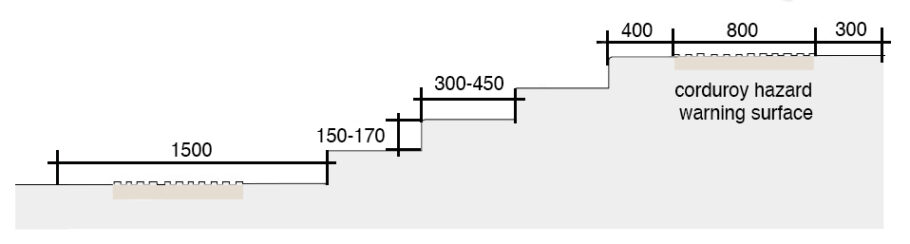
Step riser height: maximum 150-170mm.
Step tread depth: minimum 300-450mm.
A slight front-fall on a step tread is important for water drainage but it should not exceed 1:50.
Note that walking frames appropriate for outdoor use need a broader tread (minimum 550mm) and shallower riser (maximum 100mm) in order to safely negotiate steps. This may be particularly relevant in a healthcare environment.
Step nosings
A smooth, rounded nosing is preferred. Avoid protruding nosings and open treads as they can be a trip hazard and some assistance dogs may refuse to climb steps with open treads.
Steps should contract visually with their background. This makes them safer to use by everyone and in particular blind and partially sighted people. This can be achieved by using a material that contrasts with the main tread or adding a contrasting strip to the nosing. Choose materials that remain slip resistant when wet or muddy.
Highlights should be 50-60mm deep and extend the full width of the step.
Step series
Steps should be uniform within a series or flight, with consistent materials, widths, front-falls, risers and treads. Select materials that provide a firm and comfortable grip and that remain slip-resistant when wet or muddy.
A flight of steps should have a clear width of at least 1200mm, and this should be at least 1000mm between handrails. If a flight is wider than 2000mm, it should be divided by a central handrail, ensuring that each channel has at least 1000mm between handrails.
Maximum rise of a single flight of steps: 2000mm.
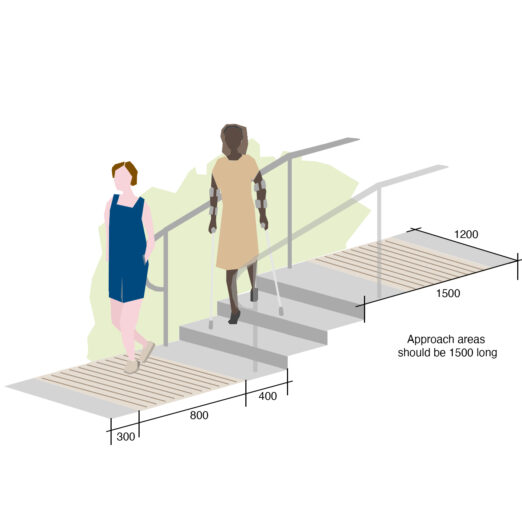
A level area of at least 1500mm x 1200mm should be provided at the top and bottom approaches to a flight of steps.
A corduroy hazard warning surface is required on the approaches to the top and bottom of steps to provide warnings for blind and partially sighted people.
Handrails
Handrails alongside ramps or steps provide reassuring, often essential, support to people with limited mobility and should be seen as an important part of ramp and step design. Provide handrails on both sides to allow people to pass each other and to consider individuals with one strong arm.
Handrails must be securely anchored and continuous throughout their run, to include any level resting places. Loose or damaged handrails are dangerous, especially where they also serve a protective role alongside a drop or hazardous area.
In remote areas of countryside it may not be possible to meet these recommendations but there may still be scope to identify features that people can use as handholds such as posts and trees.
Handrail positioning
Top rail at 900-1000mm from the pitch line of the ramp or step.
A mid rail at 600-750mm considers wheelchair users, children and people of short stature.
A bottom rail at 100mm will provide extra reassurance as a wheel stop for wheelchairs, mobility vehicles and pushchairs.
Continue the rail for 300mm beyond the top and bottom of the ramp or flight of steps to ensure that people find support before they start or finish using the ramp or steps. This also serves as an important guide to blind and partially sighted people. Continue the rail along landings on multiple ramps or flights of steps. For entrance steps and ramps extend the rail to the door.
Ensure that handrails do not impinge on the minimum clear width of the route.
If located against a wall or fence, there should be clearance of 50-75mm to give room for fingers to grip. Avoid thorny plants or abrasive fencing alongside.
Handrail detail
Choose handrails that are easy and comfortable to grasp, a round or oval section is best. The ends should be rounded off or curved for safety.
Top rail diameter: 40-50mm.
Lower rail diameter: 25-32mm, graspable by children.
Ensure the end of the rail does not create a hook point for clothing or harnesses. This can be achieved by curving the end of the rail downwards or aligning it with a support post.
Durability and maintenance are important considerations when selecting materials for handrails.
Maintenance
Steps and handrails should be checked regularly to ensure that they in good repair. It is important that handrails remain properly secured and that there is no splintering of cracking which can make them uncomfortable or even dangerous to use. Steps should be kept free of debris and checked for signs of deterioration.